


Don't Forget

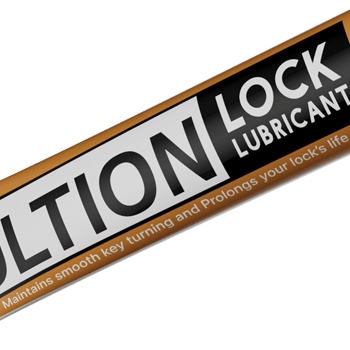
Stop key jamming with Ultion Lock Lubricant
Apply every 6 months to maintain guarantees
£12.95
Your cart is currently empty!

Blog > Ultion’s Guide to Improving Home Security With former Scotland Yard detective Peter Bleksley
September 27, 2026
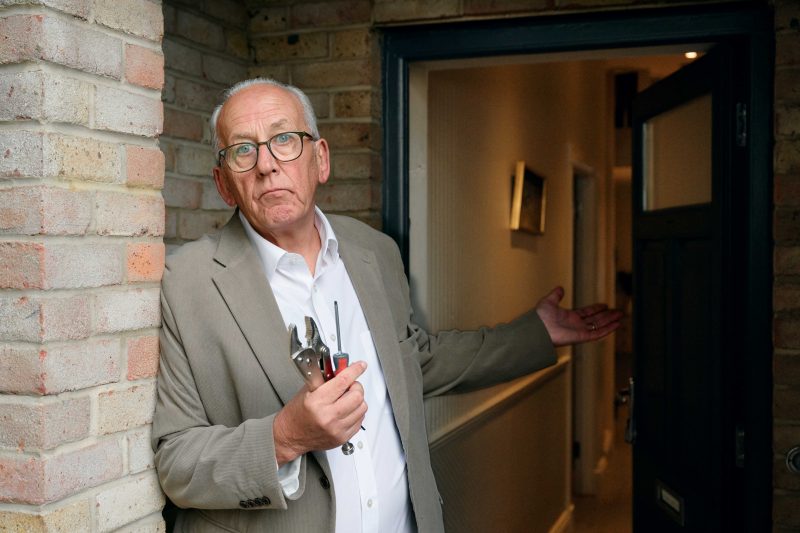
You lock the front door when you leave. Perhaps you have an alarm, a video doorbell or security cameras. But how much do you really know about the security of your home?
New research commissioned by Ultion has revealed a striking gap between how secure British homeowners feel and how much they actually know about the things protecting them.
Two in five Brits (41%) cannot account for exactly how many keys to their home exist. More than one in ten (13%) have given somebody a key to their current home that was never returned, while one in five (20%) have never changed their front door lock despite not knowing who else may have a key.
Four in five (79%) do not know what security standard their front door lock meets.
Yet 44% still believe their home would be difficult for an experienced burglar to break into.
As part of Ultion’s Britain’s Most Breakable Homes campaign, former Scotland Yard detective Peter Bleksley has helped identify some of the common security blind spots that can make an ordinary home a more attractive target.
The good news is that improving your home security does not necessarily mean turning your house into a fortress.
It starts with removing the easy opportunities.
For most people, house keys accumulate gradually.
One goes to a parent. Another to the cleaner. One goes to a neighbour while you are away. Children get their own copies. A tradesperson may have one temporarily. Tenants and relationships change. Keys are lost and occasionally turn up again months later.
Over time it can become surprisingly difficult to know exactly how many copies exist.
Ultion’s research found that 41% of Brits cannot account for exactly how many keys to their home exist and 13% know they have given somebody a key that was never returned.
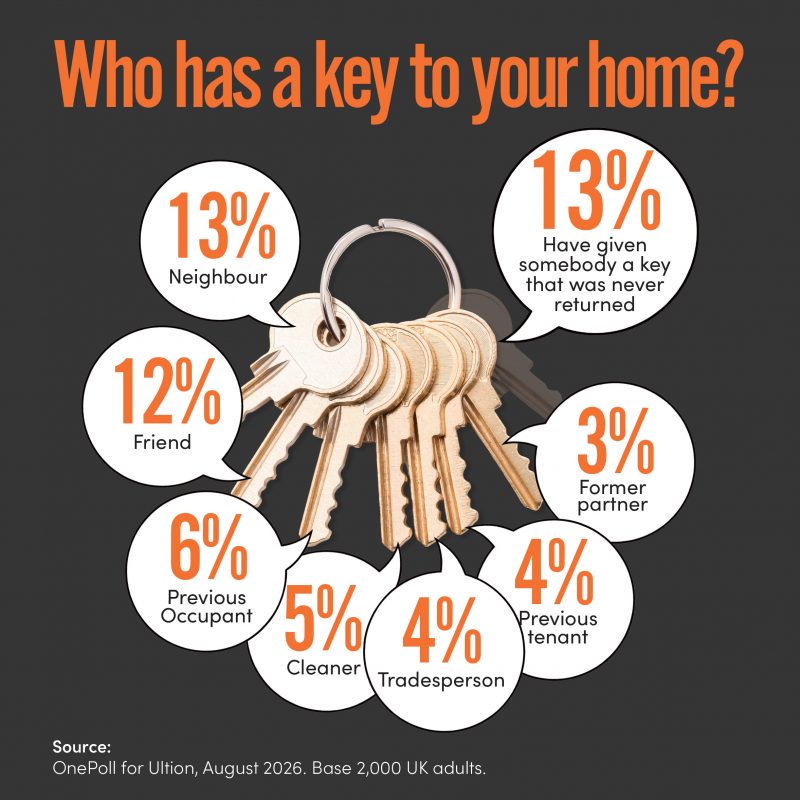
Peter’s advice is to think about access to your home in exactly the same way you would think about access to your bank account or phone: you should know who has it.
Do a key audit
Write down everyone who currently has a key to your property.
Think beyond the obvious family members and consider:
If you cannot confidently account for the keys to your property, consider changing the lock rather than simply hoping an unknown copy never reappears.
This is especially important when moving into a new home.
You may have been handed two or three keys on completion, but there is usually no way of knowing how many copies were made by previous occupants.
It may feel ingenious when you first choose the hiding place.
Unfortunately, the obvious hiding places are obvious to other people too.
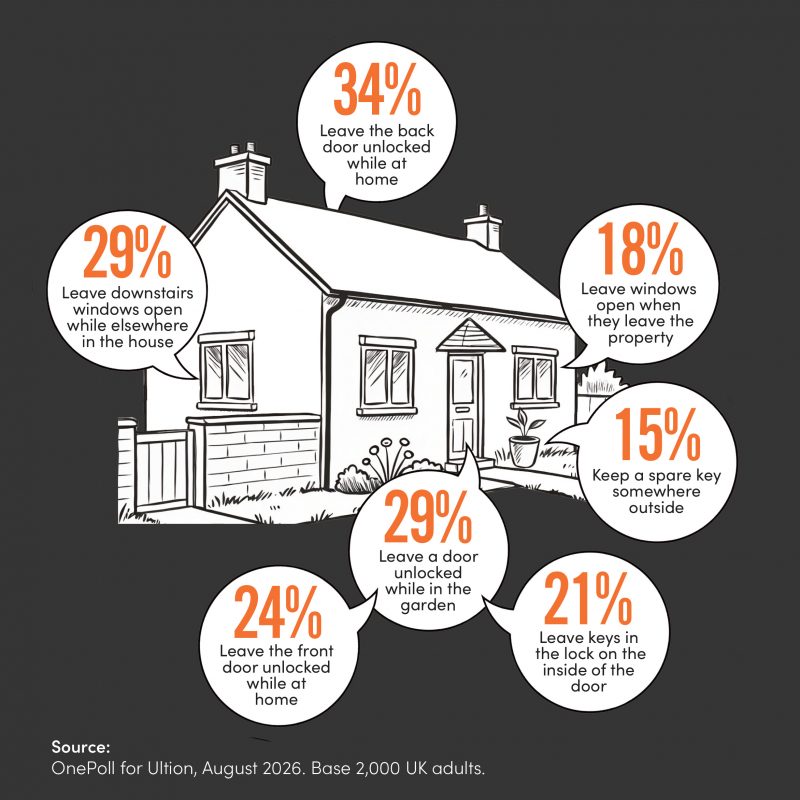
Ultion’s research found that 15% of Brits still keep a spare key somewhere outside their home, including beneath plant pots and doormats.
If somebody needs emergency access, give the spare to a trusted person or use a properly designed secure access solution rather than leaving the key around the property.
And never label a spare set of keys with your full address.
A door can look solid without necessarily having a high-security lock.
In fact, Ultion’s research found 79% of people don’t know what security standard their front door lock meets, while more than a third simply retained whichever lock was already fitted to their door.
That matters because your lock cylinder is one of the components standing between the outside world and your home.
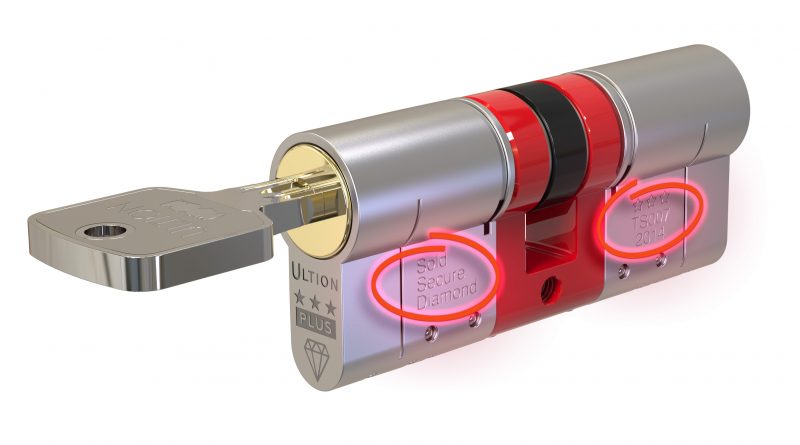
Current police crime-prevention advice recommends that, when replacing a euro cylinder, homeowners choose a TS007 3-star rated cylinder.
Look for independently recognised security credentials rather than relying simply on the appearance or price of a lock.
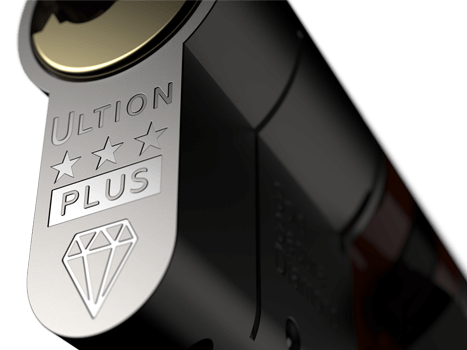
Ultion 3 Star PLUS, for example, carries a TS007 3-star rating, Sold Secure Diamond approval and Secured by Design Police Preferred Specification.
Your front-door check
Ask:
What lock is fitted?
What security standard does it meet?
Do I know how old it is?
Did I choose it, or did it simply come with the house?
If you cannot answer those questions, it is worth finding out.
Home security often comes down to everyday habits rather than expensive technology.
Police.uk advises people with many modern multipoint/uPVC doors to remember: lift, lock and remove. The locking points need to be correctly engaged rather than assuming that pulling the door shut has secured everything.
Make locking the house a deliberate routine whenever you leave and before going to bed.
Check the front door.
Check the back door.
Check patio and side doors.
Check accessible windows.
Security products only work when they’re actually being used.
Twenty-one per cent of people surveyed by Ultion leave their keys in the lock on the inside of their door.
Keeping house or car keys close to an entrance can also make attractive possessions unnecessarily accessible.
Bleksley has previously warned homeowners against leaving valuable car keys in plain sight close to the front door. Police guidance similarly recommends keeping keys away from exterior doors and windows.
Choose a sensible place for keys that members of the household can access when needed but which isn’t immediately visible or reachable from outside.
Remember, though, that home security should never compromise fire safety. Everyone in the household should know how to exit the property quickly in an emergency.
One of Peter’s simplest pieces of published advice is one of the most useful: stop looking at your house like its owner.
We become accustomed to our surroundings and stop noticing weaknesses.
Instead, stand outside your property and look at it as a stranger would.
Could somebody approach the rear of the house unseen?
Is a side gate unsecured?
Are ground-floor windows routinely left open?
Could bins, garden furniture or other objects make an accessible window easier to reach?
Can valuable belongings be seen through the window?
Does your shed contain tools that could be stolen or used against the property?
Peter has even suggested asking a trusted neighbour or friend to look around the outside of your home and identify weaknesses you may have stopped noticing.
Police guidance similarly advises homeowners to remove potential access aids around windows and to consider security across the whole property rather than simply the front door.
We naturally focus on the front door because it is the entrance we use most often.
A burglar doesn’t have to.
Back doors, patio doors, side doors, accessible windows, garages and doors connecting garages to homes should all form part of your security check.
Police guidance describes a home as only as secure as its weakest point of entry.
Walk around the entire property and ask the same questions of every entrance that you ask of your front door.
A high-security lock on the front offers little comfort if another external entrance has been neglected for years.
An open or unsecured window is an opportunity.
Police.uk recommends key-operated locks for accessible windows and reminds homeowners that window locks only offer protection when they are actually used. It also warns that upper-floor windows should not automatically be regarded as inaccessible.
Before leaving home or going to bed, make checking the windows part of the same routine as checking your doors.
If you are replacing windows, look for security-accredited products meeting appropriate British standards.
Most burglars want to avoid being seen, heard or delayed.
That is why visible layers of security can matter.
Peter Bleksley has previously recommended measures including burglar alarms, security cameras, video doorbells and exterior lighting as ways of making a property less appealing to an opportunist.
Police advice similarly says burglars are more likely to feel exposed if they believe a neighbour or passer-by may notice them.
That does not mean buying every security gadget available.
Think in layers:
A secure door and lock make entry harder.
Good lighting increases visibility.
An alarm increases the risk of attention.
Cameras and video doorbells can add deterrence and potentially provide evidence.
Neighbour awareness adds another pair of eyes.
The objective is simple: remove the impression that yours is an easy house to target.
Cameras and alarms are useful security layers.
They are not substitutes for physical security.
A camera may record somebody approaching your home and an alarm may alert you after somebody has entered. Your doors, windows and locks are designed to help stop them gaining access in the first place.
Start with the physical security of the property and then layer technology around it.
Knowing where your existing keys are is one part of key security.
Knowing who can make another copy is another.
For Ultion homeowners, registering an Ultion lock provides access to KeyControl, which uses a unique security code designed to prevent additional keys being ordered without the owner’s authorisation.
That is particularly relevant given the findings of Britain’s Most Breakable Homes.
If you lend somebody a conventional key, you may not necessarily know whether another copy has been made.
Think of key control as part of access control. It isn’t simply who has my key today? but who could create another one tomorrow?
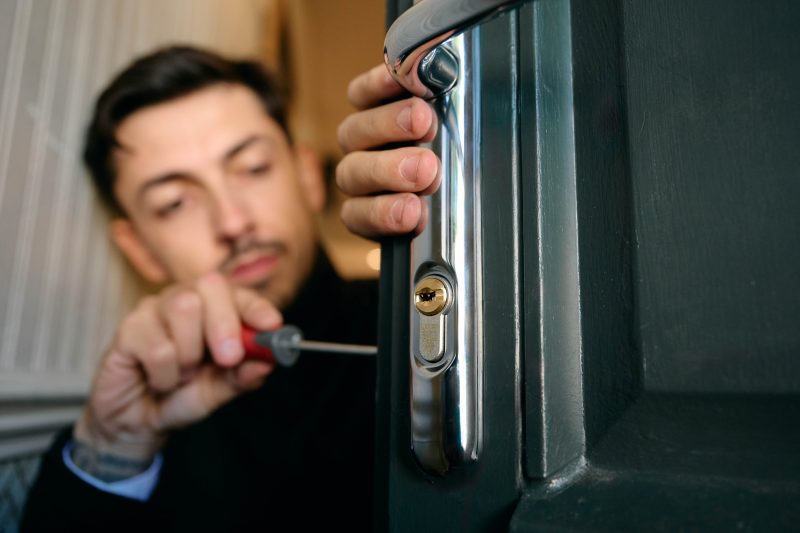
One of the most revealing findings from Ultion’s research was that Brits prioritise getting their Wi-Fi working above replacing the front-door locks when moving home.
The router can wait.
When you inherit a property, you also inherit its security history.
You probably don’t know how many occupants have lived there.
You don’t know how many keys they had cut.
You don’t know which relatives, neighbours or tradespeople were given copies.
Changing the external locks gives the new occupants a clean slate and restores control over who can access the property.
Make it part of your moving-home checklist alongside utilities, insurance and changing your address.
Sometimes the house itself isn’t the ultimate target.
Police.uk notes that burglars may select a property after spotting a particular car, motorcycle or bicycle they want to steal, knowing that the keys are likely to be inside the home.
Bleksley has warned against leaving car keys visible by the front door.
Keep keys out of obvious sight, secure garages and outbuildings, and don’t advertise expensive new purchases by leaving branded packaging outside for prolonged periods.
Garages and sheds often contain some of the most valuable things outside the main house: bicycles, power tools, garden equipment and sports gear.
Police also warns that insecure outbuildings can contain tools which could potentially be used to assist entry into the main property.
Use appropriate locks on sheds, gates and garages and make sure the fittings surrounding the lock are equally robust.
A strong padlock attached to a weak fixing is still a weak security system.
Burglars do not need a formal invitation to know nobody is home.
Think carefully about what the outside of your property communicates when you’re away.
Mail accumulating.
Bins that never move.
A house remaining completely dark night after night.
Social posts announcing a two-week holiday while you’re still away.
Peter’s underlying principle is useful here: try to see your home through the eyes of somebody assessing whether it presents an easy opportunity.
Use timers or smart lighting where appropriate, ask a trusted neighbour to keep an eye on things and avoid unnecessarily advertising that the property is empty.
Stand outside your front door and answer these ten questions:
Every “no” or “I don’t know” gives you somewhere to start.
After years spent investigating criminals, Peter’s message is reassuringly straightforward.
Burglars generally don’t want confrontation.
They don’t want unnecessary noise.
They don’t want delay.
And they don’t want to be caught.
They look for opportunity.
Your job isn’t to make your house impenetrable. It is to remove as many easy opportunities as possible and make attempting to enter your home slower, noisier and riskier.
Often, that begins with the most basic questions.
Who has a key to my house?
What lock is actually on my front door?
And if somebody stood outside my property today, what weakness would they notice that I’ve stopped seeing?
September 27, 2026
September 27, 2026